| trains-worldexpresses.com |

| |||||||
| TRAINS | World-Trains | Orient-Ex | Mideast | Indian Mail | Transsiberian | Rome-Ex | Cape to Cairo | Sud-Ex | ...adieu... |
| The Myth | Chronology | Taurus - Express | To Arabia! | Trans - Iran | Trans - Asia | Travels - Reisen | Farewell Karachi Mail | |||||||||
|
T h e M y t h - a n d F u t u r e
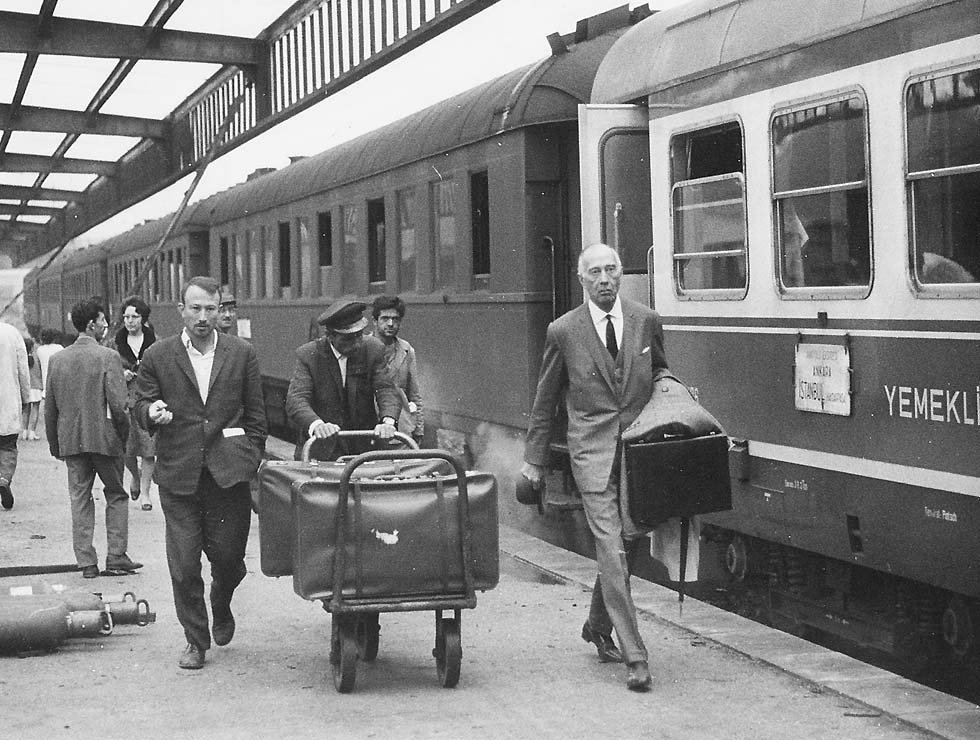
The Middle East, for Europeans "The Orient", should have been connected with Istanbul by the German empire's "Bagdadbahn". It proved a political failure and after WWI there was no much interest to continue its construction work. Only around 1929 the Simplon-Orient-Express conference targeted a future extension of that train from Calais to Cairo and Baghdad. First step was the creation of the Taurus-Express in 1930. It included Wagons-Lits sleeping cars (until 1972) and diners, but like every train in Mideast it consisted mainly of state railways' coaches. From 1927 an exclusive Wagons-Lits train, the Anatolie-Express, did run from Istanbul to Ankara. During WWII there was the unwritten law that German officials used that train and British ones the Taurus-Express. When in 1943 the German spy "Cicero" in Ankara had discovered top-secret documents about the Allies' planned Normandie invasion, he took the Anatolie-Express in order to catch the plane Istanbul - Berlin - and his cabin neighbor was a British officer! Nevertheless he had a safe journey (Hitler however did not believe in the documents and the Allied invasion took place).
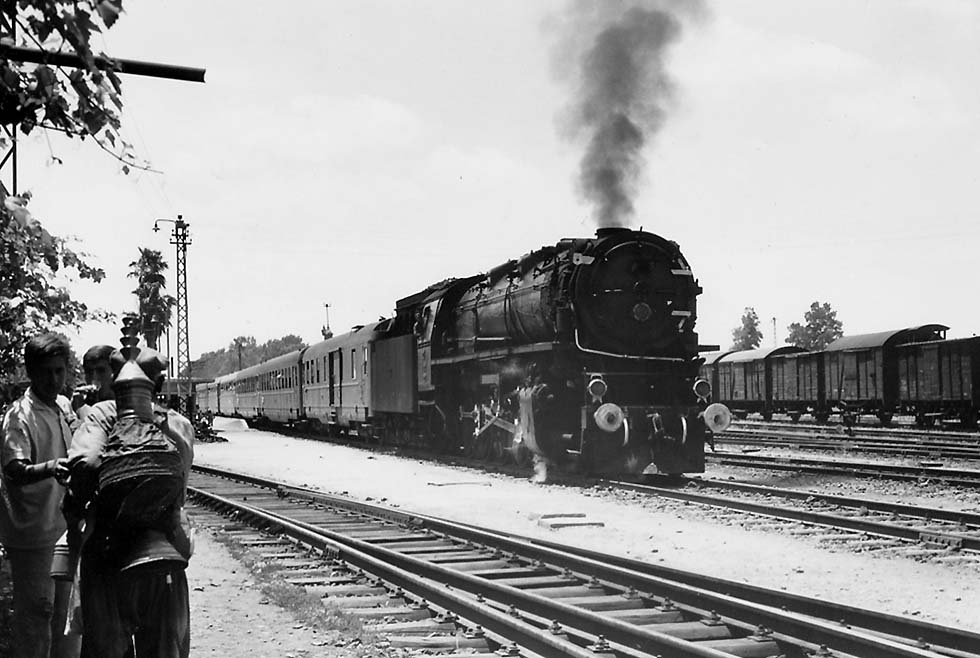
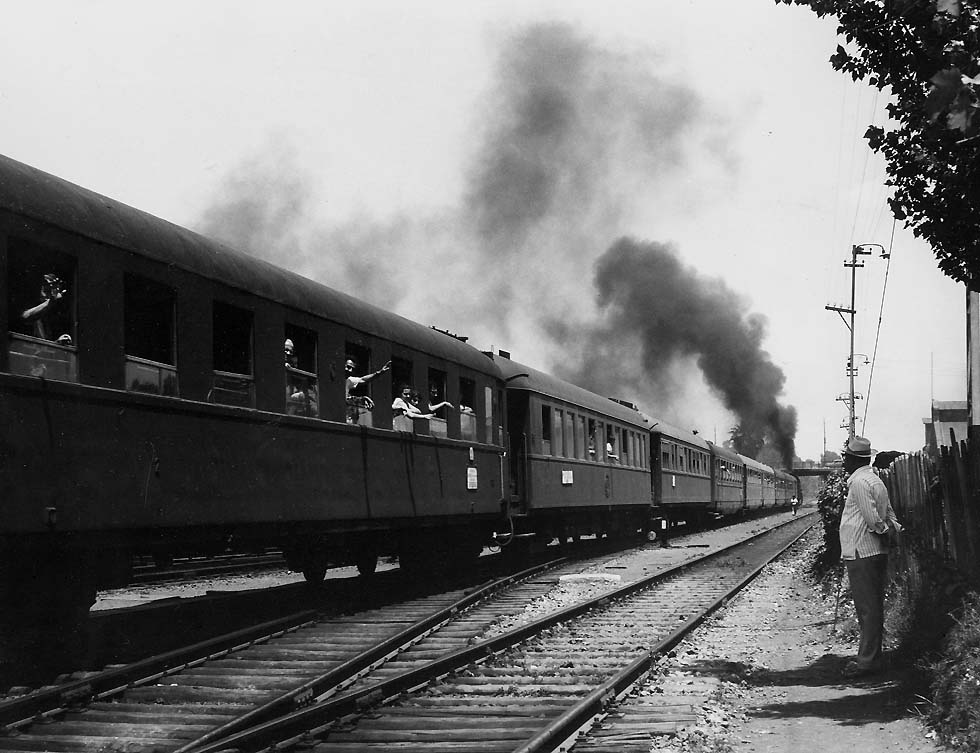
 Taurus-Express Istanbul – Baghdad waiting between Al Qamishliye and El Yaroubieh for the Taurus-Express Baghdad – Istanbul to pass by, its smoke cloud appearing on the horizon, August 1972 (WS) In 1940 the Taurus-Express had reached Baghdad and for the Mosul-Baghdad section of the Iraqi State Railways streamlined Pacifics were delivered from England. They became known as the "Coronation", for their appearance resembled the famous Coronation class of the London-Midland. Four locomotives have been built, but only three ones arrived, the fourth one was sunk with its ship. At Baghdad passengers could change to the meter-gauge Basrah Mail, which connected with the British India steamers. A later photograph by Colonel Kenneth Cantlie shows this train, consisting of old British-built cars and an American MacArthur type steam locomotive with an additional water-tank wagon. During WWII also the through line to Cairo was completed and once again the timetable conference asked for an extension of the express to Cairo. The link through the Lebanon however was reserved for the British army and in 1948 the Middle East decided for war, not peace. The line from Turkey to Iran, climbing up to an altitude of more than 2000m, completed in 1970, was a strategic CENTO railway. There were Iranian 1st class couchette cars, but the sleeping car Tehran - Frankfurt, proposed by Iran, did not come. After Khomeini's revolution, the Tehran - Istanbul service, previously booked up for a month, was closed down. Also the Taurus-Express Istanbul - Baghdad often was interrupted. And if not, ten hours late-running has been normal. Then it was stopped east of Gaziantep, Turkey. Surprisingly, with the new century some passenger services from Turkey to Iran and Iraq re-emerged. And Iran bought old ex-CIWL sleeping cars (LX and Y types) and diners (ex WP) from Spain. In Iraq a line Basrah-Kuwait was envisioned and a link with the Trans-Iranian railway became a project. This mountainous route had served during World War II for supplying the Soviet Union via the Gulf and the Caspian Sea. In the East in 1918 India's NWR reached Zahedan in Iran, but there was no connection further westward. The Orient-Express from Europe to India remained a fiction. And also the Soviet's dream of an own network in Afghanistan and possibly to the Indian Ocean could not be realized. High-Speed In Turkey, economically far ahead of its neighboring countries, the long-distance trains no longer are competitive. Already in 1944 Turkey had got a fast twin-unit diesel railcar set MT5201. The next ones went to Slovakia, then Russia and one became the Soviet experimental turbo-powered TP. However, like the triple-units from MAN 1951 and from Fiat 1961 they were no high-speed trains. A step into railways’ future was done in Turkey with opening of the first high-speed section between Istanbul and Ankara in April 2009. Ankara – Konya followed in 2010, the Bosporus Tunnel was announced for 2012 and an extension of the high-speed network to Edirne on the European side and to Antalya, Izmir, Sivas and Kayseri is under construction. In 2012 Railway Gazette Intl reported a 70% completion of the line from Kars to neighboring Georgia and the intention of building a line from Kars to the border of Iran. With its high-speed network, Turkey will become more advanced on the rail sector than many other European countries. The first semi high-speed train series, introduced in 2009 for running at 250km/h, is the HT65000 derivative from the Spanish S-120 for 25kV50Hz with distributed power, built by CAF. The 6-car train set consists of one business class car and 1st class cars with a buffet. The ICE-type Velaro absolved tests in Turkey and it started service Ankara - Konya, but in 2015 President Erdogan had concluded also cooperation with China. The first standard-gauge rail connection between Europe and Asia was achieved on 29Oct 2013 with inauguration of the ‘Marmaray’ tunnel, an immersed tube beneath the Bosphorus. The second phase concerns the connecting lines.  Siemens Velaro Turkey. (Siemens PRESS-picture)
Decades ago, dreams of high-speed lines had emerged also in Iraq. The modern railway age really had started in Israel, when in 1993 IC3 diesel multiple units from Denmark were introduced between Haifa and Tel Aviv, later running at 180 km/h. For around 2016 completion of a fast link to Jerusalem was announced. And always there have been fantastic projects on the Arabian peninsula. A sensation in 2006 was the publication of studies for a "Transrapid" maglev airport link in Qatar.  Ankara railway station, built under Ataturk, by Architect Bonatz, the designer also of Stuttgart Hbf (WS)  Mavi Tren Istanbul - Ankara, an accelerated daylight express, Alsthom class DE24, near Cevicli 1983 (WS)
Download this picture with 1500 x 1000 pix, 300 dpi (682 KB)
 Intercity of Israel Railways, resembling the Danish IC-3 type, Tel Aviv 1994 (WS)
Download this picture with 1500 x 1000 pix, 300 dpi (683 KB)
Literature by the author, covering the railway history of all Mideast countries, Uzbekistan, Afghanistan and Pakistan, including train formations, locomotive and CIWL car lists: Expresszuege im Vorderen Orient, Düsseldorf 1989 (sold out) The book is placed in the libraries: Bayerische Staatsbibliothek, Munich; The British Museum, Central Library, London; DB-Museum, Nurnberg; Deutsches Museum, Munich; Israel Railway Museum, Haifa; Musée Français du Chemin de Fer, Mulhouse; Museum für Verkehr und Technik, Berlin National Railway Museum, York, UK Wien Museum, Vienna. See also George Behrend: Yatakli Vagon.
|