| trains-worldexpresses.com |

| |||||||
| TRAINS | World-Trains | Orient-Ex | Mideast | Indian Mail | Transsiberian | Rome-Ex | Cape to Cairo | Sud-Ex | ...adieu... |
|
The Myth |
Chronology |
Nord-Express |
Siberien-Express |
Nordroute |
Kurier 1 |
Transmanchourien |
Shanghai-Express |
Allied Forces |
Blauer Express | Moskva-Express | Eastern Europe | Baltics and Finland | Red Arrow | Moscow - Beijing | Tourist Specials | China | Far East | Japan | Travels - Reisen | Sibérie adieu | |||||||||
|
T h e M y t h
 Tyumen railway station, a rare postcard published by the Czech Legion, which fought in Siberia during WWI
Trans-Siberian and Ost-West-Express, everybody has heard these names - that's the railway of the Tsars, of the revolution, the line of the mass killers Hitler, Stalin and Mao, the line of the refugees, the line of the Cold War, the line of hell. It's the railway of the most fantastic journeys, too. Journeys into another world, to the snow-fields of Siberia or Mongolia, to China, North Korea, even to Vietnam. A lot of nice books have been written about, but the complete history of its trains never has been published. It had to remain a secret, almost like the secrets of the KGB… the mystery of the expresses between the West of Europe and the East of Asia….
The connection from the West by de-Luxe Nord Express is well known and also its delay by Royal Prussian haughtiness until its start in 1896. Some enthusiasts know also, that after World War II this train in France was hauled by one of the most beautiful locomotives, Marc de Caso’s “la divine” 232U1. Belgium had still Europe’s heaviest Pacifics in use. In East Germany, engineer Max Baumberg got in 1961 the occasion to create the then fastest steam locomotive of Europe with the rebuilt 18 202 Pacific and in 1990 it hauled the first tourist train Berlin-Koenigsberg, now Kaliningrad, consisting of ex-GDR government cars. But there are mysteries, too. Who knows the fate of Poland’s streamlined Pacific Pm 36-1, on exhibition at Paris in 1937, probably scrapped in Stalin’s Soviet Union? Only her “naked” sister Pm 36-2, temporarily renumbered Pm 36-1, is preserved. Polish Mikados were the successful engines, after the Mountains Pu 29 had failed. Another question: Did communists really dream of a fantastic train from Russia to Madrid, when they would have won the Spanish civil war? After more than half a century it became reality with the Soviet Moscow - Madrid sleeping car. Or what about the locomotive designs (reportedly by Floridsdorf in Soviet-occupied Austria after WWII) for a small Niagara and a Hudson with a height of 5.30m, unsuitable for existing European lines. Was it the dream of a Soviet “Magistrale” through Western Europe? Hitler’s project of a hyper broad gauge (3000 mm) railway to the Caucasus and even Siberia remained a fool’s dream. He has fulfilled "only" his other dream, killing millions of jews - and the holocaust transports were ordered by his DR chef and minister of transport Dr. Julius Dorpmueller and undersecretary Ganzenmueller to be handled with priority. For Hitler obviously they were more important than troop transports. It's the question if the other devil, Stalin, had taken up the idea of a hyper broad gauge, or not. Being shy of flying he had ordered to lay the Russian broad gauge (1524/1520 mm) to Potsdam for his journey to the peace conference in 1945. On the same track did come the first through express from Moscow to Berlin and with it appeared wooden ex-Wagons-Lits cars. In the years after World War II the lists of secrets continued. On October 22, 1946 the action “Oswakin” started, transporting German air and space technicians and equipment by freight trains from Dessau, Bleicherode and Neu-Strassfurt to Russia. In March 1947 some CIWL sleeping-cars from Paris to Brest, the new Russian border station, were added to the Nord-Expess, carrying politicians to the Foreign Secretary conference at Moscow. On the western section of the Nord-Express line ran the Allies’ military expresses to the enclave West-Berlin and not even the Soviet blockade could stop them. A wonderful lady (who’s grandma had dined with the Kaiser) told that her aunt escaped from the Soviet zone hidden away in an American officer’s sleeping-compartment. In 1955 the “Adenauer-Zug” started from Bonn to Moscow. German chancellor Konrad Adenauer did fly to that conference, but the train served as a headquarter, safe from surveillance. The result of the state visit was the return of the surviving German prisoners of war, by boxcars. Soviet politics had changed since the death of Stalin in 1953. In 1960 for the first time Russian sleeping cars did run regularly to Paris, carried through by politics against bureaucracy. Was it Khrushchev’s idea? There are still other secrets. Had tourists, who saw an uncompleted railway at Suwalki region in northeastern Poland, discovered a strategic link from Belarus to Kaliningrad, the conquered Koenigsberg, which never was completed? Another strategic line, published by Western press, was the broad gauge link via Zahony in Hungary to Agerdomayor at the Romanian border, a backdoor into Ceausescu’s empire. A visit in 1989 showed that there was nothing - except the guards armed with Kalashnikovs coming down from the watchtower - and they let us pass.  Soviet publication of Russian profile locomotive designs, entitled "Austrian railway network". After WWII the Soviets had secretly intended to build a Russian broad-gauge line to occupied Vienna. (coll. Werner Umlauft, J.B. Kronawitter)  The Czech 3-cylinder compound 499.0, which never was built (a drawing smuggled out from the Soviet bloc, collection J.B. Kronawitter)
Also the regular trains, mainly their locomotives, had their mysteries. From October 1945 the Soviet officers traveling between Berlin and Moscow had to change train at Brest. The blue train - known as “Blauer Zug” or “Blauer Express” from Berlin, later from the Soviets’ headquarters at Wuensdorf, was hauled by German 01 class Pacifics through Poland, the “Kolonnenloks”. Who ever had the occasion to speak to its drivers? Decades ago, one of them, Hans Miersch, told to the author from his trips on a 52 class war-engine, hauling freight trains with requisitioned goods to the new Soviet border stations. They lived in a covered wagon, then they “acquired” a van, paid by smuggling, and the accompanying Russians helped them. Once a 01 of the “Blauer Express” had a defect and their 52 hauled it through Poland. They nicknamed that train number 2 and 1 also “Blauer Heinrich”. In East Germany several steam locomotives were rebuilt for firing coal powder, a development pushed forward by engineer Hans Wendler. In 1953 the tenwheeler 17 1104 with this technology was equipped with two huge tenders for a range far beyond the GDR’s borders. Was it indented to run regularly as far as Brest? It remained a secret. Historian Ulrich Walluhn reported about a slightly different sister: “The 17 1119 is rumored having undertaken even several times a representative run with the trains D2/ D1 Berlin – Brest – Berlin without change of engine.“ Also almost nobody knows that the rare Hungarian 303 class Hudsons, which hauled Moscow bound trains between Budapest and Miskolc, initially were intended as a streamlined copy of the German record-breaking 05. The proposed Polish Hudsons and Niagaras never were built. Who knows about the red Mitropa cars and maybe, even streamlined ex-German 03.10 Pacifics in Russia after the war, or the mysterious locomotive prototypes, the unsuccessful Teploparavoz (steam-combustion) engines or the three different “2-3-2” Hudsons? The fate of the Czech 3-cylinder compound Mountain of the 476 class, given as a present to Stalin, for longtime was unclear, until Czech historians found out, that it was scrapped in 1967. After WWII Czech engineers had traveled to France where they studied Andre Chapelon’s three-cylinder compound 242-A1. They were so impressed, that they planned the 499 Niagara class on the same principles and artist Vilem Kreibich created fantastic streamlining studies. After the communists took over, the project was stopped and any publication was prevented. East German engineers Baumberg and Toepelmann admired French Mountain type engines which they saw during the war, but the East German Mountain was not built. The communist authorities allowed Max Baumberg to meet engineer J.B. Kronawitter in the West, supposedly in order to spy out West German projects, and Baumberg let out some Eastern secrets, but cautiously he made no drawings! Other ideas such as the Soviet nuclear locomotive project for a 4.5 m broad gauge trans-Himalayan railway may have been clever fiction stories. From a Russian-German meeting, Henschel engineer Professor Kademann (the designer of the Chinese diesel-hydraulic NY7) reported to the author that no real project existed. A German design for a DB engine with a helium-cooled reactor, looking like a twin-V200, had been published, but this was a study only. The way across the Himalaya was barricaded since 1950, when China had conquered and subjugated Tibet. Reality were the tests of requisitioned German 15kVac locomotives on the Kozhva - Vorkuta line during 1948 - 51. However, only the E44 and E94 classes were tested, not the elegant E18 express passenger engines, which had been captured too. Finally the Soviet Union, as well as China, decided for the 25kV system. All the tests with gas-turbine and gas-generator engines led nowhere.  Experimental oil-fired high-pressure steam motor test engine V5-01 from Kolomna 1937 in the Soviet Union (a drawing based on a picture in a Russian Rakov edition), one of the numerous designs for Hitler's 3m broad gauge project and the DB study for a nuclear-powered locomotive in the 50's (contemporary press)
When the communists had established their railway SZD, they introduced sleeping accommodation for every passenger on every night train, a comfort unknown in Europe and in America and specially in the Soviets' satellite states, where eight persons were cramped into narrow seating compartments. The party bosses' Leningrad - Moscow Red Arrow (initially blue!) night express on the former Nikolai -, then October railway always had been something better, last not least by its beautiful stewardesses. Not to speak about the blue "Lux" - the special train for Stalin and his guests (and the NKWD intelligence staff) for trips to the Black Sea. It was so top-secret, that the train's manager then had to be executed. And what's about the real Trans-Siberian? Had all its secrets been written down in literature? Who knew, that the Soviets' wooden de-Luxe cars, which appeared in Berlin in 1945, had been captured during the turbulent epoch described by Boris Pasternak in "Dr. Shiwago", when the Siberian Express crossed the lines of the Red and the White. It was stopped in 1918, when the "white" Admiral Kolchak ruled at Omsk. Even a"Transsiberien" is reported to have been running from Vladivostok to Omsk and one of the two trains obviously was an exclusive CIWL consist. On November 13, 1919, Kolchak left Omsk with five trains and the Russian gold treasure. The Czech Legion protected the admiral - and "sold" him at Irkutsk for thirty wagons with coal. So the legion could reach the Pacific, and Kolchak was executed. In the Far East, the last pirate on rails, Semyonoff, robbed a whole de-Luxe train for his own use. It was filled with precious prey, "senseless luxury",as the French journalist Joseph Kessel reported, excellent drinks from Cognac to Champagne (though the commander preferred Vodka from the two-liter bottle), and weapons. Always a locomotive was ready for departure. "One never knows", said Semyonoff (under Stalin he was sentenced to death). In the Trans-Siberian Kurier 2/1 between the wars and obviously even after WWII did run the requisitioned wooden ex-CIWL sleepers, diners and vans with bath. Who knows all its Western starting points in the years before… the Polish, the Lithuanian, the Latvian places where passengers had to change from standard to broad gauge - Negoreloye, Stolpce, Riga, Bigosovo, Gudagojis, Vilnius or maybe Radviliskis? Japan, misusing China’s “Last Emperor”, had built up its satellite state Manchukuo. In this troubled region did run Asia’s fastest train, the steam-hauled streamliner Asia Limited. The French journalist Saurwein traveled from Jilin (Kirin) to Korea on an observation saloon in front of a train, accompanied by guards, while the locomotive was pushing in the rear - by security reasons. In Chiang Kai-shek’s China, the Shanghai - Beijing through train needed armored cars with guns in front of the locomotive, in the middle of the train and in the rear - immortalized by Sternberg and Marlene Dietrich by the movie “Shanghai Express”. Then the Japanese invasion stopped it. Chiang’s supply railway to Burma never was built and the occupiers now had other trains. The most important one was the Tairiku from the Korean harbor Busan, with ferry connection from Japan, just through to Beijing (the formation of this train is handed down!). And the most important spy of WWII, the German communist Dr. Richard Sorge, who informed Stalin that Japan was not planning an attack on the Soviet Union, had his collaborator on this South Manchuria Railway. Stalin could then throw his troops westward, against the German aggressors - via the trans-Siberian railway! After WWII, during the Cold War, the railways of the East once again became an interesting place for espionage. The Soviets based nuclear missiles on trains camouflaged as freight and a Western cargo container, equipped with automatic cameras, was discovered on the trans-Siberian line. True or not? In 2005 a railway enthusiast, Johannes Gloeckner, uncovered the secret: SS24 missiles were mounted on wagons which looked like refrigerator vans, hauled by TE6 (one half of the TE2) and DM62 (2M62) diesels of the army, stationed behind barbed wire at Valishog close to Kostrova, not far away from the Moscow - Danilov - Kirov line of the Siberian expresses. Trans-Siberian trains were a reality during war and peace times. Reality of communism was shown on the through trains from Moscow to China and North Korea by the extreme border controls on both ends of an illuminated restricted area with kilometers of barbed wire, checking the trains from below, from above and inside, with soldiers, dogs, search-lights, mirrors and guns. Reality is also the strategic line through Mongolia. A Russian P36 steam locomotive is on exhibition there, but propaganda had told, that the transit line was dieselized from the beginning and that Soviet broad gauge even entered China, maybe planned through to Beijing? …And what about Japan’s streamliner “Asia”? A similar train appeared in communist China and than possibly it was hidden away. Or the Chinese communists’ secret project of a huge Niagara type express passenger steam locomotive? When Dave Wardale during the ‘80’s was invited by the ministry in order to improve existing QJ engines (and the railway administration prevented his work in favor of dieselization), he did not discover any drawing for the Niagara. Maybe the Soviets had taken along all information? American and Australian thinktanks then had found out, by combining some internal notes about cylinder dimensions, that it was not a copy of the Russian P36, but it should follow the less sophisticated layout of the standard QJ, based on the Soviet LV freight engine. When in North Vietnam German war-locomotives of series 52 were discovered, Australian historian Bill Pearce questioned, if the “empty” designation DK4 in China might have been reserved for ex-52s from Russia, which never came. There were other secrets too. In 1971, Mao was to be assassinated by his presumed successor Lin Biao during a ride on his special train to Shanghai. His crew was surprised as Mao started earlier, and he had a safe trip. Lin Biao then died by a mysterious airplane crash. Mao’s personal train, built by VEB Goerlitz, East Germany, was so secret that even the producer did not know the final car numberings. Its saloons later did not appear on the tourist special Peking-Orient-Express, as advertisements stated. Even more mysterious was the blue/white special of Kim Jl Sung from North Korea. It was so top-secret, that on a trip to Eastern Europe even the officials responsible for a safe journey were not allowed to take a photograph. Isolated North Korea had also a 3-car electric unit of own production, called “Juche” or “self-reliance”, the country’s political slogan.
Also in the 21st century there are mysteries: Will the magnetic levitation technology, successfully capable of speeds up to 500 km/h, used on Shanghai's airport link, bring new intercity connections elsewhere? May Kazakhstan's Talgo train open up a new future for night trains in remote countries? Ideas like a bridge from Sakhalin or a tunnel from Korea to Japan however are science fiction rather than projects. Literature by the author, the only manuscript which covers the trains' complete history from Europe to China, Korea and Japan, including the beginning of Russian and Chinese railway projects, timetables, trains’ formations, CIWL and Russian car lists, locomotive lists of European and Asien countries and the myth of the Trans Siberian: Transibirien und Ost-West-Express An illustrated manuscript is already placed in the Bayerische Staatsbibliothek, Munich; DB-Museum, Nurnberg; Musee francais du chemin de fer, Mulhouse; Museum fuer Verkehr und Technik, Berlin.
Text in German, excerpt from Transsibirien und Ost-West-Express: MYTHOS OST-WEST Mythos von der längsten Eisenbahnstrecke der Welt: Moskau - Wladiwostok 9297 Kilometer laut "Cook", Paris - Wladiwostok 12 309 Kilometer, Paris - Hong Kong, der längste jemals gefahrene Zuglauf, 14 749 Kilometer... Die Distanzen alleine sind es aber ebenso wenig wie die dreihundert Milliarden jährlicher Passagierkilometer, die zwei Millionen Eisenbahner oder die fünfzigtausend Lokomotiven der Sowjetunion, welche den Mythos der Ost-West-Strecke begründet haben. "Mythos Berlin" lautete der Titel einer Ausstellung mit Eisenbahnexponat, "Paris - Moskau" war eine Ausstellung in Paris, "Transsib-Prospekt" hiess eine Arbeit auf der Documenta - und alle zeigten, dass Mythen subjektiv sind, wie auch der Mythos der Ost-West-Strecke. Der schweizerisch-französische Dichter Blaise Cendrars empfand ihn so: "Ich war 16 000 Meilen vom Ort meiner Geburt entfernt Ich war in Moskau, der Stadt der tausendunddrei Glockentürme und der sieben Bahnhöfe Und ich hatte nicht genug an den tausendunddrei Glockentürmen und den sieben Bahnhöfen..." Er fuhr in der phantastischen Dichtung "La prose du Transsiberien et de la petite Jeanne de France" mit einer kleinen Kokotte von Paris in das Sibirien des russisch-japanischen Krieges: "Je suis en route J'ai toujours ete en route Je suis en route avec la petite Jehanne de France" Die Illustration der Erstausgabe gestaltete die expressionistische Malerin Sonia Delaunay. Cassandre, der weltberühmte in der Ukraine geborene Grafiker, malte 1927 für die französische Nordbahn die Plakate "Nord-Express", auf denen jener legendäre Ostwestzug von Paris der fernen Heimat des Künstlers entgegenstürmt. Der Juwelier Faberg versetzte den Zaren mit einem Transsibirien-Express, der in ein goldenes Osterei passte, in Erstaunen... Auch die Ingenieure leisteten sich Träume. Als Marc de Caso eine Lokomotive mit drei Innentriebwerken sowie eine Turbinenlokomotive entwarf und aus letzterer "La divine", die "göttliche" 232 U 1 entwickelte, war das die Erfüllung des Traumes von der schönsten Dampflokomotive und - sie zog den Nord-Express! 1937 wurde auf der Expo in Paris die stromlinienförmige polnische Pm 36-1 und je eine sowjetische Lokomotive der Serien "Josef Stalin" und "Felix Dscherschinskij" ausgestellt und sie entführten die Gedanken der Betrachter nach Osten, ebenso wie dies die dreiteilige Dampfmotorlok getan hätte, die der Danziger Professor Neesen mit der Idee konzipiert hatte, damit Schnellfahrzüge Lissabon - St.Petersburg zu bespannen... Der Ingenieur Max Baumberg konnte in der DDR noch 1961 den Traum von der damals schnellsten Dampflok Europas verwirklichen, nachdem ihm sein Studienkollege, Verkehrsminister Kramer, die schwarze Stromlinientenderlok 61 002 zum Umbau überlassen hatte. Und diese 18 201 zog 1990 erstmals den Staatszug der DDR auf einer Touristenfahrt Berlin - Russland! Der deutsche Designer Luigi Colani stellte in jenem Jahr der Ost-West-Euphorie gar das Modell eines Zuges vor, der seiner Meinung nach mit Schallgeschwindigkeit von Gibraltar nach Moskau rasen sollte. Der Autor hingegen träumte seinen Traum von den grossen Ostwestzügen Ende der fünfziger Jahre vor den zwei Meter dreißig hohen Rädern der in Hamm rostend abgestellten 05, jener durch Adolf Wolff konzipierten Weltrekordlokomotive, die, zum Schrottpreis ausgeschrieben, angeblich erst nach einem Kaufangebot durch die DDR vor der Vernichtung bewahrt wurde. Tatsächlich hatte sie während kurzer Zeit internationale Züge auf der Ostweststrecke befördert. Tolstoi beendete seine Träume auf einem Bahnhof. Er hatte in der Nacht vom 27. auf den 28. November 1910 sein Gut Jasnaja Poljana verlassen, erkrankte im Eisenbahnwagen dritter Klasse und starb im Hause des Bahnhofsvorstehers von Astapovo. Wieviele Schicksale seiner Charaktere hatten zum Mythos der östlichen Eisenbahnzüge beigetragen? "Mit furchtbarer Gewalt raste und pfiff der Sturm hinter der Ecke des Stationsgebäudes hervor, zwischen den Rädern und dem Gestänge des Waggons. Stangen, Waggons, Menschen, alles, was man sah, war von der einen Seite mit einer dicken Schneeschicht bedeckt, die immer dicker wurde", so beschreibt er den Halt des Zuges von Moskau nach St. Petersburg, während dessen Wronskij zum zweitenmal Anna Karenina begegnete. "In demselben Augenblick fegte der Wind, als wolle er alle Hindernisse beseitigen, den Schnee von den Dächern der Waggons und rüttelte er an irgendeinem losgerissenen Blechschild, während vorn, klagend und düster, der tiefe Pfiff der Lokomotive ertönte." Dostojewskijs "Idiot" beginnt auf der Eisenbahn: "Es war Ende November, bei Tauwetter, als gegen neun Uhr morgens ein Zug der Petersburg-Warschauer Bahn sich mit Volldampf Petersburg näherte. Das Wetter war so feucht und neblig, dass es kaum richtig hell werden wollte; aus den Wagenfenstern konnte man zehn Schritte rechts und links vom Bahndamm nur mit Mühe etwas erkennen." Iwan Bunins Eisenbahn ist noch düsterer: "Der Zug wird dunkler, die Wagen rollen, tragen mich mit sich fort, und ich falle, falle tiefer und tiefer, so als versänke ich in die Erde unter ihnen." Und Andrej Bely schrieb: "Der Weg war so lang; Weiten waren zu durchmessen, wo inmitten der schwarzen Nacht am Bahndamm keine einzige Station nistete wie ein schwarzer, von Kerzen umstellter Sarg." Mit den wirklichen Expresszügen war als Kind Vladimir Nabokov gereist, dessen Onkel einen Herrensitz bei dem Dorf Roschdestweno zwischen St.Petersburg und Luga besass und dieser Onkel "bestach den Nordexpress, eigens seinetwegen auf unserem kleinen Bahnhof zu halten...". So wie Nabokov hatte ein anderer, weniger bekannter russischer Schriftsteller, Sergej von Markov, der nach der Revolution wie so viele Adelige als Schlafwagenschaffner arbeitete, im Kindesalter die zaristischen Expresszüge kennengelernt: "Schnellzug Sewastopol - Charkow - Moskau - Petersburg! Blaue, braune, grüne Schnellzugswagen. Dazwischen, vornehm reserviert, mit mattschimmernden Holztafeln verkleidet, die beiden Schlafwagen." Von den Expresszügen der Zarenzeit erzählte auch ein Mitglied einer baltischen Adelsfamilie, der Regisseur Gregorij von Leitis: Seine Grossmutter aus St.Petersburg, eine uneheliche Orloff, reiste jeden Spätwinter mit viel Personal an die Riviera, wo sie eine Villa besass, denn man gehörte ja nicht zu den Grossfürsten, die ein halbes Hotel mieten konnten; im Sommer fuhr man zur Ausbeutung auf die Güter und im Herbst begab man sich mit dem Nord-Express nach Paris, um die Garderobe für die Petersburger Ballsaison einzukaufen... Nicht in den Expresszügen reiste Scholem Alejchem, der Erzähler des Jiddischen, wenn er ins "Schtetl" fuhr, etwa nach Baranowitschi: "In der dritten Klasse sassen wir Handvoll Juden dicht gepackt - man könnte sagen, aneinandergeklebt. Tatsächlich sassen nicht alle, sondern nur diejenigen, die sich auf die wenigen Plätze gestürzt hatten. Die anderen standen...". "'Revolution...Revolution' hasteten die Maschinen. Das war der Atem selbst der Nacht. Der Schrei der Lokomotiven des 'Train Bleu' oder der 'Fleche d'Or', mit Volldampf hindurchjagend zwischen Signal und Semaphor, die Weichen überrennend, sich in Mauereinschnitte schmetternd, sich unter Brücken hindurchschleudernd wie eine Explosion: 'Revolution!' Und 'Re-Re-Re!...' antwortete von fern die Pfeife der Lokomotiven der internationalen Grands Express, die in Sturmeseile in der Tiefe der Nacht verschwanden und ihre Räder sangen: 'volution-volution-volution'..." "'Revolution!' Et 'R‚-R‚-R‚!...' repetait le sifflet lointain des locomotives des grands express internationaux qui s'evanouissaient en coup de vent au fond de la nuit dans une grande trainee de roues: 'volution-volution-volution...'" Wie Ekrasit explodiert bei Cendrars der Hymnus an die Revolution und für Aragon wird nichts den Roten Zug aufhalten, der die Bahnhöfe, die Signale überrennt, quer durch das ganze Universum: "Le train rouge s'ebranle et rien ne l'arretera U R S S U R S S U R S S C'est le train de l'etoile rouge qui brule les gares, les signaux, les airs SSSR Octobre octobre c'est l'express octobre a travers l'univers SS SR SSSR SSSR SSSR." In Trauburgs Revolutionsfilm "Der blaue Express" sind es Wagons-Lits, in Wirklichkeit waren es preussische Schnellzugwagen und ein Gepäckwagen, welche die Revolution transportierten. Am 9. April 1917 liess Generalstabschef Ludendorff ohne Wissen des Kaisers Lenin von Zürich über Schweden nach Finnland ausreisen, von wo aus er am 16. April mit dem planmässigen Zug nach Petersburg gelangte... Der Mythos vom Eisenbahnzug, der Weltgeschichte machte, war geboren. "In diesem Augenblick brach in der Nähe der Station ein Donnergetöse los, das sogar das Rauschen des Wasserfalls übertönte: An der haltenden Wagenreihe fuhr mit voller Geschwindigkeit auf dem zweiten Gleis der Ausweichstelle ein Kurierzug älterer Bauart vorüber, dessen Dröhnen und Rattern bald leiser wurde. Noch einmal sah man seine Schlusslichter aufblitzen, dann war er verschwunden. Auf dem Fussboden des Waggons nahmen die beiden Männer ihre Unterhaltung wieder auf... 'Das muss Strelnikow gewesen sein. Ein gepanzerter Sonderzug'." So beschreibt Boris Pasternak in "Doktor Schiwago" einen der Befehlszüge während der Wirren. Und: "Auf der Bahnstrecke steht in Jurjatino, unter Volldampf, ein Dienstzug der Fernöstlichen Regierung... Er besteht zur Hälfte aus internationalen Schlafwagen..." Bei Konsalik liest sich das so: "'Auf! Auf!' schrie er. 'Er kommt! Ein langer Zug ist's, direkt aus Moskau. Der Express! Fährt quer durch die Roten und die Weissen'...". Oder: "Die langsame Fortbewegung des Zuges inmitten einer von Menschen wimmelnden Strasse, das Pfeifen der Zugsirene, welches das Geschrei der ungeordneten Massen zerreisst...". So beginnt Sternbergs Film "Shanghai Express" nach der Kritik durch G. Scognamillo. Er steigert sich "bis zu der Szene des Überfalls auf den Militärzug, dort ist der Film von absoluter Brutalität und durch die vernebelten Aufnahmen, die in einem beklemmenden Halbdunkel gedreht sind, unterstreicht er noch die Atmosphäre der Angst und des bestialischen Terrors...". Das war im chinesischen Bürgerkrieg. "Moskau wird von einem Zimmer des Savoy-Hotels aus gezeigt, wo jemand logiert, der mit unbekanntem Ziel und überaus grossen Geldmitteln im internationalen Waggon herumgereist ist. Bitte keine Beunruhigung, ihr Mitbürger...", schrieb Ossip Mandelstam im stalinistisch-kleinbürgerlichen Moskau in einer Filmkritik, und dazu gar: "Wie langweilig doch, in einer Arbeiterrepublik zu leben." Natürlich starb Mandelstam, Russlands begabtester Lyriker der Moderne, im Gulag - und zwar 1938 bei Wladiwostok. Bald machten die internationalen Expresszüge zwischen Ost und West, zwischen Angst und Terror, wieder Weltgeschichte. Die Ex-Frau eines Sowjetdiplomaten - markante Blondine, Litauerin, grosse grüne Augen - erzählte, dass ein Bekannter, "ein sehr wichtiger Mann", 1940 von den Deutschen aus Südamerika auf dem einzig sicheren Weg via Japan, den Eisenbahnknoten Harbin ("Harbin gehört zu den dreissig grössten Städten der Welt, Berlin nicht") und Transsib heimgeholt wurde und, dass sein Zug in Wirballen 22 Minuten Verspätung gehabt hatte, weswegen der Zweite Weltkrieg um 22 Minuten verschoben wurde. Legende oder nicht - die Reisen über die Ostweststrecke in die Katastrophe hatten schon vorher begonnen: Am 4. Juni 1934 begab sich der todkranke Reichspräsident Hindenburg im Salonwagen von Berlin ostwärts an seinen Ruhesitz Neudeck und Hitler konnte die Macht ergreifen. Am Abend des 3. September 1939 fuhren drei Sonderzüge, der "Führerzug", der Zug "Göring" und Himmlers Zug "Heinrich" nach Osten, zum Auftakt des Zweiten Weltkriegs. Hitlers Zug war im Reich oft mit zwei Stromlinienlok der Baureihe 03 10 bespannt, der gleichen, welche die Nazi am 12. November 1940 auch ihrem Gast, Stalins Aussenminister Molotow, zur Verfügung stellten. In diesem Jahr konnten sie Frankreich mit Unterzeichnung des Waffenstillstands in jenem CIWL-Speisewagen 2419 demütigen, in dem 1918 die deutsche Delegation die Waffenniederlegung unterschrieben hatte. Im Frühjahr 1919 sei täglich ein Sonderzug mit Schlaf- und Sitzwagen von Berlin nach Paris gefahren, jetzt verkehrte angeblich täglich ein Kurierzug in entgegengesetzter Richtung von Berlin nach Hitlers Hauptquartier "Wolfschanze" bei Rastenburg. Kein blosser Mythos war das Ziel der Nazi, "Lebensraum" im Osten zu erobern. Von diesem Ziel hatten schon die Agrarromantiker der zwanziger Jahre geträumt. Einer von ihnen hiess Heinrich Himmler. "Am unteren Rand der Viehwagen-Luke angefroren wie ganz kleine Eiszapfen die dünnen Finger eines Kindes." Lothar Kusche Menschen im Güterwagen Die Transporte ins KZ gehören zur Geschichte der Ostweststrecke wie die Beutetour des Hermann Göring nach Paris, für die er, mitten im Krieg, 46 Lokomotiven in Anspruch genommen hatte. Die Frontsoldaten erfuhren als letzte davon, aber sie kamen als erste in Gefangenschaft. "Als sie unten durch die dunkle Unterführung schritten, hörten sie den Zug oben auf den Bahnsteig rollen, und die sonore Stimme im Lautsprecher sagte ganz sanft: 'Fronturlauberzug von Paris nach Przemysl über...'". Ähnlich wie hier für Heinrich Böll mag für viele der Leidensweg begonnen haben. In Sibirien ging er weiter: "Diese Station nun heisst Omsk. Der Tag der Fahrt ist der sechsundzwanzigste. Aus den Waggons... werden die Leichen in den kalten Tag hinaus gehoben und an die Böschung eines etwas höher gelegenen Nachbargleises gelegt, Holz wird hereingenommen. Die Handreichungen sind gewohnt und eingelernt. Aber die Stadt jenseits der Toten und der Geleise ist schön." Für diesen Gefangenen - Josef Martin Bauer, "So weit die Füsse tragen" - war die Odyssee im persischen Tabriz zu Ende. Für viele, aus Mitteleuropa, Frankreich, Südosten, endete sie in Auschwitz in der Woiwodschaft Krakau. Millionen Männer, Frauen und Kinder wurden, getrennt in Güterwagen gepfercht, auf ihrer letzten Fahrt dorthin gebracht – und die Reichsbahn erntete für jeden den vollen 3.Klasse-Tarif… Die Ostweststrecken sind auch die Bahnen der Flüchtlinge. "Ich war damals fast noch ein Säugling, als wir aus Königsberg fortmussten. Meine Mutter trug mich auf dem Arm. Den Koffer, den sie nicht mehr schleppen konnte, liess sie am Bahnsteig zurück...", so lautete eine der vielen Schilderungen. Die Ostweststrecken sind aber auch die Bahnen der Heimkehrer, und nicht alle kehrten freiwillig heim. Churchill's Aussenminister Eden hatte Stalin die russischen Soldaten der auf deutscher Seite kämpfenden Wlassow-Armee versprochen, doch man lieferte gleichzeitig Emigranten von 1917 und deren Kinder aus. "Einige begingen lieber Selbstmord, als zurückzukehren, viele wurden hingerichtet, sobald sie in die Hände der Sowjets gerieten", berichtete der Historiker Graf Nikolai Tolstoi. Die letzten deutschen Soldaten holte 1955 Konrad Adenauer durch seinen denkwürdigen Moskauer Staatsbesuch heim. Mit Güterzügen kamen sie in Herleshausen an der Zonengrenze an. Adenauer reiste mit der Lufthansa, aber als abhörsicheres Hauptquartier und zum Transport des Mercedes-300 fuhren zwei Sonderzüge voraus, darin der "Kanzlerwagen", der einst Hermann Göring und dann der US Army gedient hatte. Die Besatzungszüge bildeten das Gegenstück zu den Heimkehrerzügen. Um den "Blauen Express" der roten Armee in Deutschland rankten sich Legenden und Mythen wie um die Reise Stalins im Sonderzug hinter geschlossenen Vorhängen zur Potsdamer Konferenz. Doch auch die Berliner Militärzüge der Westalliierten gingen in die Erinnerung ein. Eine Adelige erzählte, wie ihre Tante von den "Amis" unter einem Schlafwagenbett versteckt aus der "Zone" nach Westen geschmuggelt wurde. Der Fachmann Walther Brandt berichtete über den häufigen Halt des amerikanischen Zuges zwischen Potsdam und Brandenburg: "Von der Bevölkerung eines nahe gelegenen Ortes fanden sich dann immer einige Leute ein. Nach ein paar Worten wurden vom Zug aus Zigaretten und manches Weissbrot herübergeworfen... Erst als die östliche Polizei aufmerksam wurde, stellte sie Posten auf, um die Deutschen von dem 'amerikanischen Zug' zu vertreiben." Einmal hatte es auch einen Attentatsversuch gegeben. Als drei westliche Aussenminister nach Berlin reisten, wurde bei Hannover ein Koffer Dynamit unter den Schienen versteckt, aber die Zündung versagte. Nirgendwo war die Nahtstelle zwischen Ost und West stärker zu spüren als auf der Bahn. Sinnbild wurden die Grenzkontrollen im Berliner Bahnhof Friedrichstrasse, Sinnbild war auch der Bahnhof Zoo, berühmt geworden durch Christiane F.: "Es war ein ungeheuer mieser Bahnhof. Da lagen Penner in ihrer Kotze, überall hingen Besoffene rum." Und Sinnbild der Teilung Deutschlands waren die "Interzonenzüge". Der in die Bundesrepublik emigrierte Erich Loest schrieb vor Jahren: "Gegen Heimweh fand ich ein Mittel... den Zug, den die Deutsche Reichsbahn jeden Tag von Berlin nach Holland schickt... Das Glanzstück ist der Speisewagen, der ist nun schon wieder museumsreif, er stammt aus der Nierentischzeit mit seinen ovalen Spiegeln und Zierleisten... In ihm trinke ich zwei Flaschen Pils aus Radeberg..." Die Ost-West-Strecke umgab der Mythos der "politischen" Strecke. In den fünfziger Jahren kehrte auf ihr Raffaels "Sixtinische Madonna" in einem sowjetischen Gepäckwagen von Moskau als Zeichen der Versöhnung nach der DDR zurück. Als 1956 der französische Kommunistenführer Thorez bei der Rückkehr aus Russland in Paris mit einem polnischen Salonwagen eintraf, identifizierte diesen die Wagons-Lits-Gesellschaft als ihr requiriertes Eigentum, doch ein politischer Eclat wurde absichtlich vermieden. Die Baupläne der "Concorde" seien, laut Nachrichtenmagazin Der Spiegel, in einer Toilette des "Ost-West-Express" nach der Sowjetunion geschmuggelt worden. "Politisch" war der versuchte Anschlag Westberliner Terroristen auf den Expresszug Moskau - Paris 1985 im Grunewald. Auch sein holländischer Flügel erschien in den Nachrichten, als 1975 syrische Terroristen einen Überfall auf dessen sowjetischen Schlafwagen vorbereiteten. Westberlins Regierender Bürgermeister Schütz wurde am 11. September 1969 in Marienborn aus dem Schlafwagen eines "Interzonenzugs" geholt. Freundlicher lasen sich die Meldungen aus dem Jahr 1970, als sich Bundeskanzler Brandt und Ulbrichts Ministerratsvorsitzender Stoph in Erfurt und dann in Kassel trafen, wozu sie ihre Sonderzüge benützten. Willy Brandt liess zu Fahrten nach Berlin bescheiden seinen Salonwagen 10205 einem Berliner Interzonenzug anhängen. Sympathisch zeigten sich polnische Dienststellen gegenüber Herbert Wehner: Nachdem dieser im Februar 1982 anlässlich einer Besuchsreise zu Regierungsschef Jaruzielski über den planmässigen Schlafwagen geklagt hatte, bekam er für die Rückfahrt einen Salonwagen zur Verfügung gestellt. Jaruzielski selber hatte keine so gute Erinnerung an die Eisenbahn. 1990 berichtete er, zitiert nach der Münchener Abendzeitung, wie er 1981 gezwungen worden war, das Kriegsrecht zu verhängen: "Bei einem Geheimtreffen in einem leeren Eisenbahnzug hätte ihm der damalige KGB- und spätere Kremlchef Andropow gedroht, in Polen einzumarschieren, wenn er die Krise nicht beende." Die Bahnstrecken in den Tiefen der Sowjetunion umgab das Geheimnis der strategischen Atomraketen. 1986 mutmasste das Pentagon die bevorstehende Stationierung der SS 24 auf Eisenbahnwagen. Im Jahr darauf meldete "Iswestja", dass ein Spionage-Container von Tokyo über die transsibirische Bahn in die Bundesrepublik expediert worden sei, der Kameras und Computer enthalten habe, die während der ganzen Fahrt aufgenommen hätten. Mit Urantransportzügen aus Sachsen und aus dem böhmischen Jachymov, einst Joachimsthal, wurde die sowjetische Atombombenproduktion aufgebaut, ein deutsch-sowjetischer Eisenbahnzug leitete die Abrüstung ein: Im Februar 1988 startete als erster unter mehreren ein Zug in Bischofswerda nach Sary-Ozek an der "Turksib", der aus zwei DR-Diesellok, einem sowjetischen "harten" Schlafwagen und Flachbordwagen bestand, beladen mit atomaren Mittelstreckenraketen des Typs SS 20, die auf Wirken von Michail (und Raissa?) Gorbatschow hin zur Verschrottung abgezogen wurden. Im Oktober 1989 erzwangen die Flüchtlingszüge aus Warschau nach Helmstedt und aus Prag nach Hof die Öffnung der deutsch-deutschen Grenze. Auch die Zeiten, die dann folgten, spiegelten sich in den Eisenbahnzügen, zumindest wenn man dem "Brief aus Warschau" des Janusz Tycner glaubt, der 1991 in der "Zeit" veröffentlicht wurde. "Nun kam er zurück, nach fast drei Jahren des ständigen Pendelns auf der Strecke Nowosibirsk - Irkutsk - Ulan Bator - Peking", schrieb jener über seinen Freund Grzegorz, der ihm eine Welt eröffnete, "in der Dollar-Noten in dicken Bündeln und Zuchtperlen in kilogrammschweren Paketen den Besitzer wechseln." Da die Bettkarten in den Zügen knapp sind, "lohnt es sich, bei grösseren Lieferungen 'privat' einen Güterwaggon zu mieten, seinen Inhalt in Ulan Bator auf ein 'privat' gechartertes Flugzeug der mongolischen Linie Miat umzuladen und nach Bratsk zu fliegen. Die Ware wird auf einem Militärflughafen von Offizieren der Roten Armee diskret in Empfang genommen und an die örtliche Mafia weitergeleitet, die für dreissig Prozent Anteil am Umsatz 'Schutz' und sorglosen Absatz garantiert." Weniger sorglos "reisten" die 30 000 Emigranten, welche allein 1992 aufgegriffen wurden, von Osten zur deutschen Grenze, meist per Bahn und oft per Bahn wieder zurück. Die Ost-West-Züge gingen in die politische Geschichte, die Karikatur und die Literatur ein. Über die literarische Szene "drüben" zur Stalinzeit hatte einst Horst Bienek geschrieben: "Wir waren auf der Suche nach dem verlorenen Proust. Vergeblich." Dafür schickte ihn Ulbricht für vier Jahre ins Gulag bei Vorkuta. Andrej Sacharow war "nur" nach Nizhni Novgorod, das damals Gorki hiess, verbannt worden, wo ihn zu Weihnachten 1986 Michail Gorbatschow anrief und ihm mitteilte, dass er frei sei. Die Welt nahm am Fernsehschirm Anteil, als er am 23. Dezember mit dem Nachtzug 37 in Moskau eintraf. Boris Pasternak hatte 1958 noch den Literatur-Nobelpreis für "Doktor Schiwago" zurückgeben müssen. Seine Schilderung einer sibirischen Bahnstrecke um 1919 steht dem Surrealen tatsächlich näher als dem Kommunismus: "Diese unterwegs festgefahrenen und unter dem Schnee begrabenen Züge bildeten ein fast ununterbrochenes Band auf Dutzenden von Wersten. Sie dienten bewaffneten Banden, die unterwegs auf den Wegen räuberten, als Festungen oder als Zufluchtsstätten für kriminelle und politische Flüchtlinge, den unfreiwilligen Herumtreibern jener Zeit, am allermeisten aber als Brudergräber und Kollektivmausoleen für Erfrorene und an Typhus Verstorbene... Ein Halbwüchsiger, der aus einem Schneeberge herauskroch, der einen internationalen Schlafwagen vollkommen verdeckte, verschwand wieder, nachdem er seine Notdurft verrichtet hatte, in seinem Unterschlupf... Vor diesen Bildern hatte man den Eindruck von etwas überirdischem. Sie erschienen wie Fragmente des ungeahnten Lebens von einem anderen Planeten, das durch ein Versehen hierher verschlagen worden war." Schwarz und surrealistisch ist auch die Erzählung von einer langen Bahnfahrt durch den polnischen Dichter Bruno Schulz: "...Nie hatte ich Waggons so archaischen Typs gesehen, geräumig wie Zimmer, dunkel und voller Verstecke, auf anderen Linien längst aus dem Verkehr gezogen. Diese Korridore, die sich unter ganz verschiedenen Winkeln brachen, diese leeren, labyrinthartigen und kalten Abteile hatten etwas seltsam Verlassenes, etwas geradezu Erschreckendes an sich..." Ein anderer polnischer Schriftsteller, Wlodzimierz Odojewski, nach dem Westen emigriert wie so viele, hatte dort seinen Proust und seinen Joyce nicht vergebens gesucht: "Er richtete sich ein wenig im Fauteuil auf und blickte auf die Strasse; sie war leer, und auf dem Sportplatz war auch noch niemand, und auch der Park war fast menschenleer, es war Mittagszeit, natürlich, da hatten die Frauen ihre Kinder zusammengepackt und waren nach Hause gegangen, aber in der Ferne sah er auf dem Bahndamm einen dunklen Punkt, dieser Punkt kam allmählich näher und wurde grösser, das mochte wohl ein Güterzug sein, denn für einen Personenzug liess man gewöhnlich das Signal eher hochgehen, ein Güterzug also, er wird gute fünf Minuten lang über den Bahndamm dahinkeuchen, ach, wie das abscheulich stank, wenn es nicht die Bahngeleise und alle die Züge hier gegeben hätte, wäre ja dieser Stadtteil nicht so übel..." Oder: "Das Gebäude sieht aus wie ein Bahnhof, nicht eben ein Hauptbahnhof, ein oder zwei Rangstufen darunter...", so beginnt "Mein Stück Zeit" des im sorbischen Sprachraum Deutschlands geborenen Jurji Brezan, und weiter: "über dem falschen Säulenportal tickt gemessen eine Uhr, nach ihr ist es null Uhr null, die Uhr ist zeigerlos. Der Mann stösst die knarrende, von vielen Füssen gestossene und vielen Koffern geschrammte Schwingtür auf - es ist tatsächlich ein Bahnhof, Schilder, Verbote, Gebote, Hinweise, Tafeln, Schalter." Welten, nicht nur geographisch, liegen zwischen dem düsteren Surrealismus der Zentraleuropäer und den Erzählungen des Literaturpreisträgers Tschingis Aitmatow aus der asiatischen Sowjetunion, aus seiner Welt der Schafzüchter und Pferdehirten: "Auf der einen Seite stiegen mit Heckenrosen bewachsene dunkle Felsen über dem Weg auf, und zur anderen toste - weit unten im Dickicht der Purpurweiden und der wildwachsenden Pappeln - der rastlose Kurkureu. Ab und zu brausten irgendwo hinter uns Eisenbahnzüge mit alles übertönendem Getöse über eine Brücke; und lange noch hallte das Klopfen der Räder nach. Es war schön, in der nächtlichen Kühle dahinzufahren, auf die schwankenden Pferderücken zu schauen, in die Augustnacht zu lauschen..." Welten liegen auch zwischen Jeanne d'Arc und der Mongolei, Worten, die den Titel zu Ulrike Ottingers Film "Johanna d'Arc of Mongolia" ergeben, der in einem surrealen Transsibirien-Express spielt, in dem Oscar Wilde's Lady Windermere ebensowenig fehlt wie eben jene Johanna, es ist wohl Cendrars' "Jeanne de France" aus der "Ode du Transsiberien", die zum Schluss einer mandeläugigen Sagenprinzessin als Idol aller Träume von Fernost im Aussichtswagen der alten South Manchuria Railway begegnet... 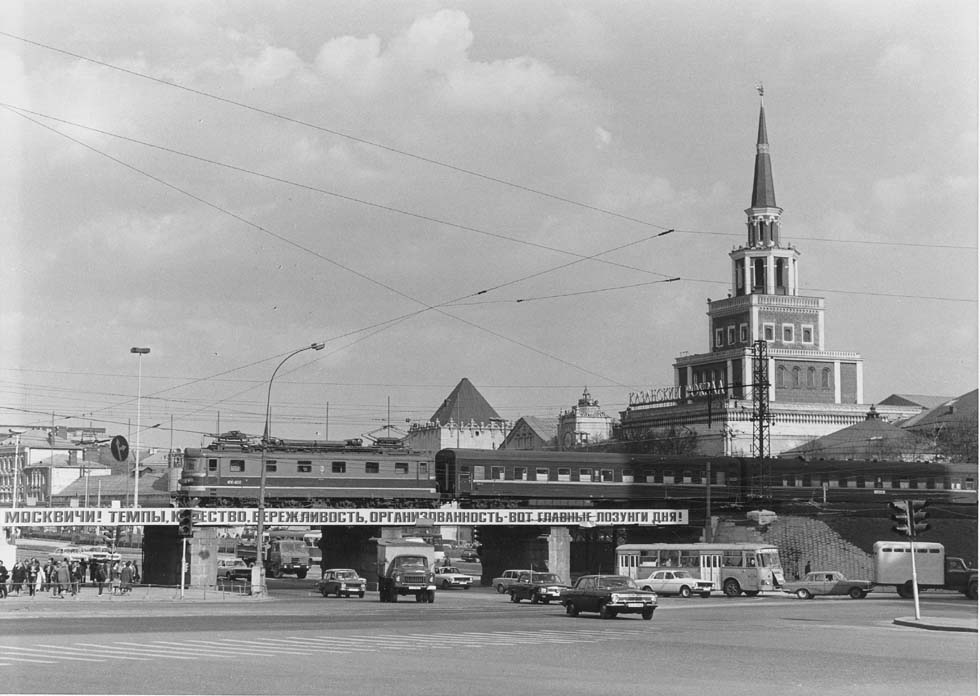 A myth nowadays – the express ‘Krim’, coming from Simferopol on the Crimean peninsula, arriving at Moscow with a ChS2 engine in May 1986, the Kazan station in the background (WS)
|