| trains-worldexpresses.com |

| |||||||
| TRAINS | World-Trains | Orient-Ex | Mideast | Indian Mail | Transsiberian | Rome-Ex | Cape to Cairo | Sud-Ex | ...adieu... |
|
The Myth |
Chronology |
Nord-Express |
Siberien-Express |
Nordroute |
Kurier 1 |
Transmanchourien |
Shanghai-Express |
Allied Forces |
Blauer Express | Moskva-Express | Eastern Europe | Baltics and Finland | Red Arrow | Moscow - Beijing | Tourist Specials | China | Far East | Japan | Travels - Reisen | Sibérie adieu | |||||||||
|
M o s c o w - B e i j i n g & R o s s i y a
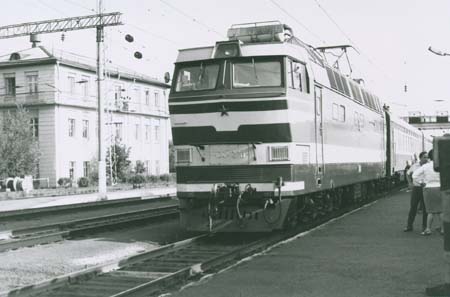
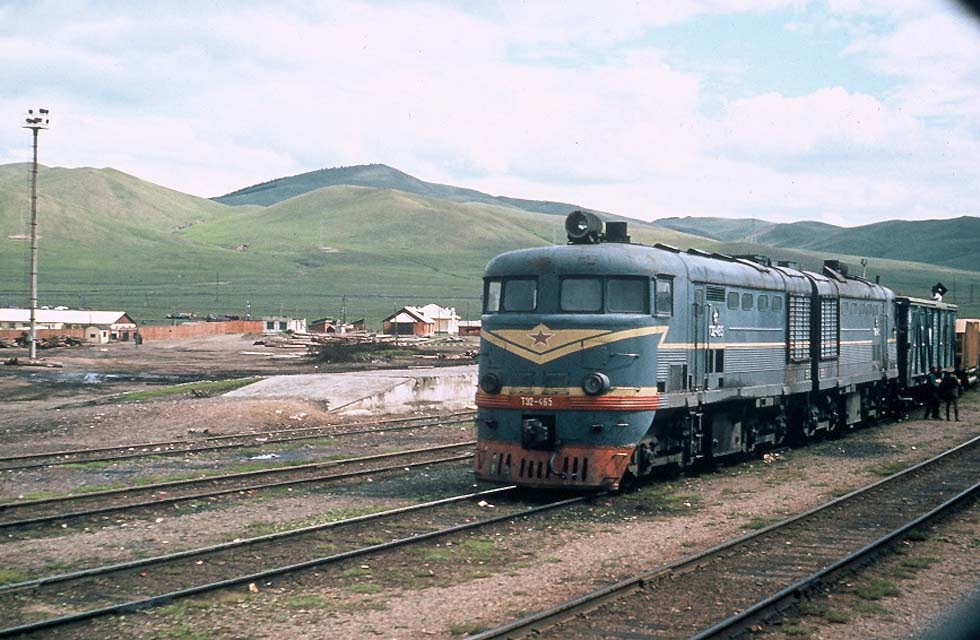
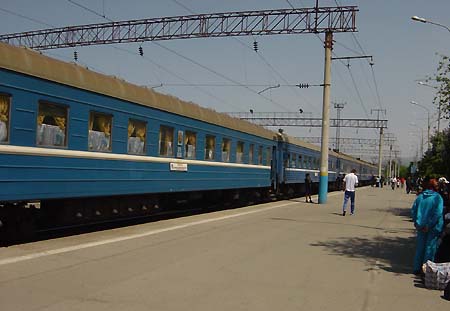
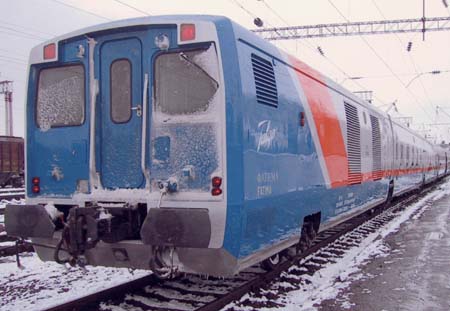
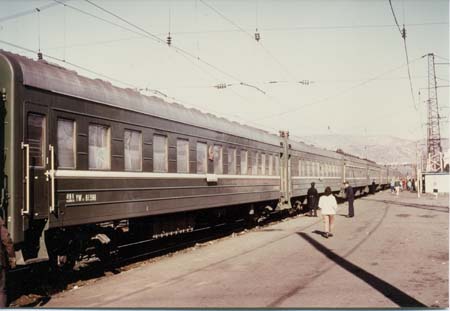
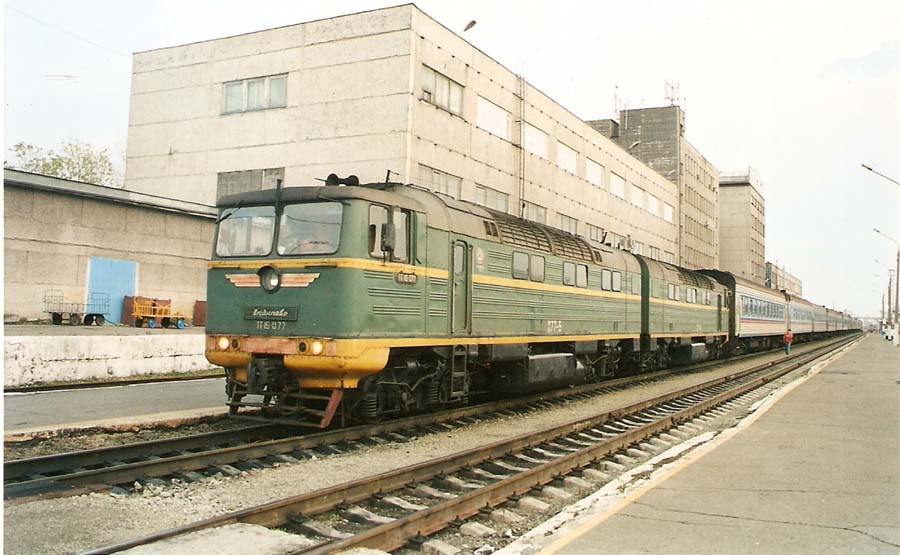
In 1954, still the time of Soviet-Chinese friendship, the Russian train Moscow - Beijing and Pyongyang started by the way of Manchuria, with change of bogies at Zabaikalsk. It consisted of the new light-green Russian sleepers 0-T. It is not known if the diner initially did run through to Beijing. The passengers at that time were under strict control by the secret service and one of them, the Berlin lawyer Dr. Reinhold Knopp, told the author a story: His traveling companion, a Soviet General, did not dare to start a conversation as long as the car's conductor was close by, for he was the KGB informer. On the new, shorter Transmongolian line the Chinese train Beijing - Moscow was inaugurated in 1959, with its better service competing with the Russian one. Initially superb menus were served in China. The sleepers and diners were built in Eastern Germany between 1955 and 59. And one of the first Chinese DF diesel prototypes, a derivative from the Russian TE3, hauled this train in China. Change of gauge initially was at Tsining, China, and only later, possibly from 1966, at Erlian on the Mongolian border. Also the Transmongolian line was dieselized from the beginning with Russian broad-gauge twin-engines TE2. After the clash between the Soviets and Mao, this was the strategic line to China, with drastic controls on the Chinese border, but also on the Russian-Mongolian frontier. Via Kazakhstan The third connection to China, via Almaty (Alma Ata), Alashankou and Urumqi, was delayed by the Russian - Chinese hostilities. The Chinese standard gauge line from the east via Lanzhou reached in 1956 Yumen, in 1960 Hami and in 1962 Urumqi. In 1990 the line via the Alatou pass was provisionally completed. Druzhba is the Kazakh and Aktogay the Chinese border station, with change of gauge. In autumn 1992 the "Genghis Khan" opened passenger services Almaty - Urumqi, but no through train Moscow - Almaty - Beijing appeared. Later the train Almaty – Urumqi was listed as “Zhibek Zholy”. A train Astana – Urumqi started in 2008 (according to Railway Gazette Intl.), listed by Cook’s via Balkash, once-weekly. Passengers of the few touristic long-distance specials had to change train at Alashankou (see chapter Tourist Specials). At Urumqi separate trains are departing for Beijing, Shanghai, Wuhan and Chengdu. A long branch line ends at Kashi, close to border of Tajikistan. On that line a direct train was listed from Korla to Lanzhou and Xian. Around 2011 connecting Urumqi with the Chinese high-speed network was concluded. At that time Moscow continued to be connected with Almaty by the train “Kazakhstan”, with Toshkent by the “Uzbekistan” and with Bishkek by the “Kirgizia”. The “Gengis Khan” was later listed as “Zhibek Zholy”, Almaty - Urumqi, with change of bogies at Druzhba. A fast night connection with sleeping-cars between Astana, the capital of Kazakhstan, and Almaty was established in 2002. Turksib.com informed: “30.IX.2002: The first high-speed train left from the station of Astana for the southern capital Almaty… The train consists of the railroad cars built by the Spanish company Patentes Talgo…13.VI.2003: 22 new Talgo coaches for Kazakhstan were unloaded at Hamina, Finland… The new coaches will be used on daily Almaty - Shymkent and Almaty - Astana trains. 19.IX.2003: New high-speed ‘Tulpar’ train departed to Almaty from the newly rebuilt main station of the fantastically upgraded capital Astana. The train covers the distance between the new and the old capitals in just 13 hours and 44 minutes (it goes twice as fast as traditional trains).” They are typical Talgo train sets, locomotive-hauled. In 2011 the first Talgo trains were delivered also to Uzbekistan, complete train-sets, the exterior resembling the Talgo for Saudi Arabia, to connect Toshkent with Samarkand. Conventional international expresses from Moscow to former Soviet countries, now independent, were registered e.g. for 2008 by Cook’s Overseas Timetable on the routes to Baki in Azerbaijan (“subject to cancellation”), to Dushanbe in Tajikistan, to Toshkent in Uzbekistan with a branch to Bishkek in Kyrgyzstan and to Qaraghandy in Kazakhstan via Astana. Passengers for China have to change trains at Almaty and at Urumqui. According to Railway Gazette Intl. a service Astana – Urumqi was opened in 2008. Expresses Urumqi - Beijing were hauled in the western region of China generally by a pair of various DF4 type diesels. Newer reports showed them on the electrified sections east of Lanzhou with SS type engines and colored cars. In 2003 the project of a Trans-Asian rail link has been published, for connecting Andijon in Kyrgyzstan via Arpa and Tomgat with Kashi in China, where trains for Korla and Urumqi are departing. It reminds the rumors in the past of gigantic Soviet dreams of a Trans Himalaya rail link to China and even India. In 2004 the different idea of a standard-gauge (!) project linking Aktau on the Caspian Sea with Aktogay in Kazakhstan and Druzhba on the Chinese border has been published. In China, building a high-speed line Urumqi – Lanzhou has started.
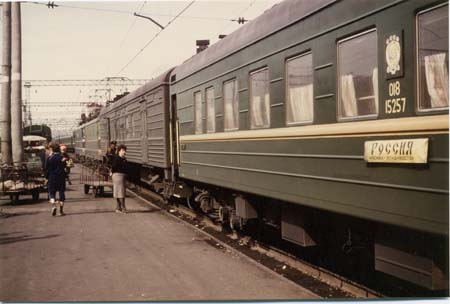
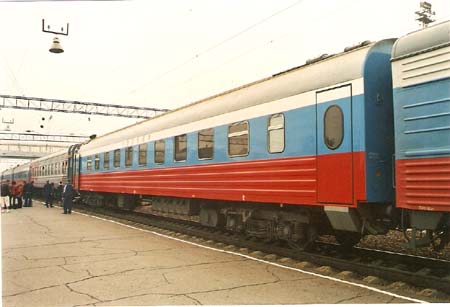
Via Siberia The Russian and the Chinese trains Moscow - Irkutsk - Beijing generally run once weekly. There are additional trains Moscow- and Irkutsk - Ulaanbaatar and there had been through cars to several places in Mongolia, possibly military bases. A service Moscow - Eerentsav - Bayantumen in eastern Mongolia obviously disappeared at the end of 2003. The longest run had the mail train (without passengers) Kaliningrad - Vladivostok. Number 2/1 "Rossiya", the successor of the pre-war Kurier 2/1, was the most important train among the Moscow - Vladivostok expresses. But from 1994 "Rossiya", its new cars now painted red/blue, no longer offered a daily departure. Nevertheless in the 21st century it continued running as well as the once-weekly express Moscow – Ulaanbaatar – Beijing, on two other days Moscow – Ulaanbaatar only, and the once-weekly Moscow – Zabaikalsk – Beijing/ Pyongyang “Vostok”, its new Russian cars being painted red/blue. And there are less prominent trains, too, experienced in 2007 by Heiko Mueller and Matthias Schulze: They took a train from Huahote in China to Ulaanbaatar, during the 11 hours’ stop at Erlian filled with traders and their merchandise, continuing the trip in Mongolia with 20 cars. Another day they took a train departing from Erdenet in Mongolia, consisting only of a M62 type engine and one Russian sleeper, at Salkhit coupled to the express Ulaanbaatar - Moscow. A study for an east-western line in Mongolia was published, being intended for freight. In 2007 the Russian ambassador started a discussion with USA and Canada about the possibility of a Bering Strait tunnel for rail and pipeline at an estimated cost of 50 billion dollar, but the USA and Canada were not interested (according to the German magazine Brandeins, July 2008). Nevertheless Russia published the proposal. But tanker and container shipping is much cheaper. Realistic was the completion of the Baikal-Amur-Magistrale in 1989, creating a second main line to Russia’s Far East by passing north of Lake Baikal. Cook’s Overseas Timertable showed e.g. in 2008 a train Moscow – Tynda and another one Tynda – Komsomolsk na Amure. Other trains had a connection to Tommot, the extension to Yakutsk being under construction at that time. Quite another matter is the ‘Polar’ railway in the north of Siberia, linking the Bovanenkovo gas field since 2010. It is a part of the Yamal project – see www.wikipedia.org. Express 4 1988 (March 29 from Moscow Yar.):
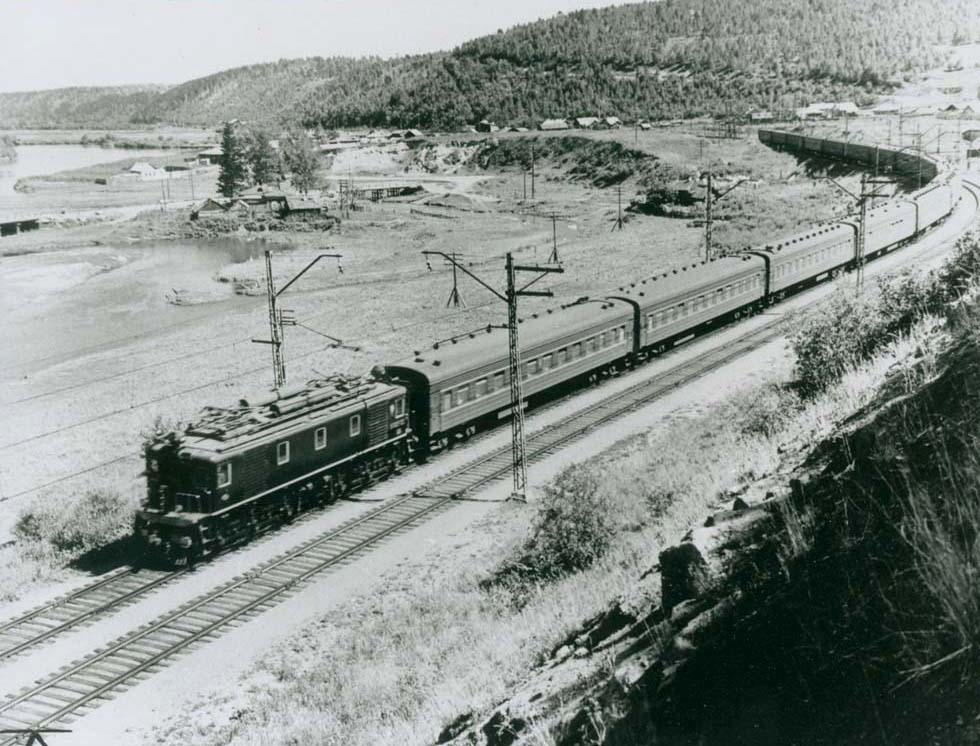
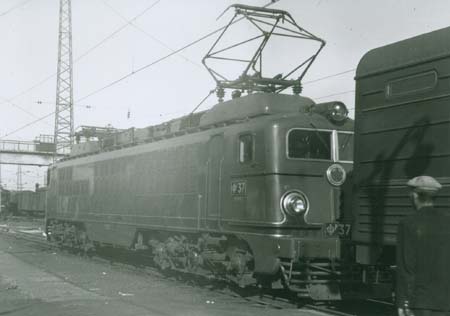
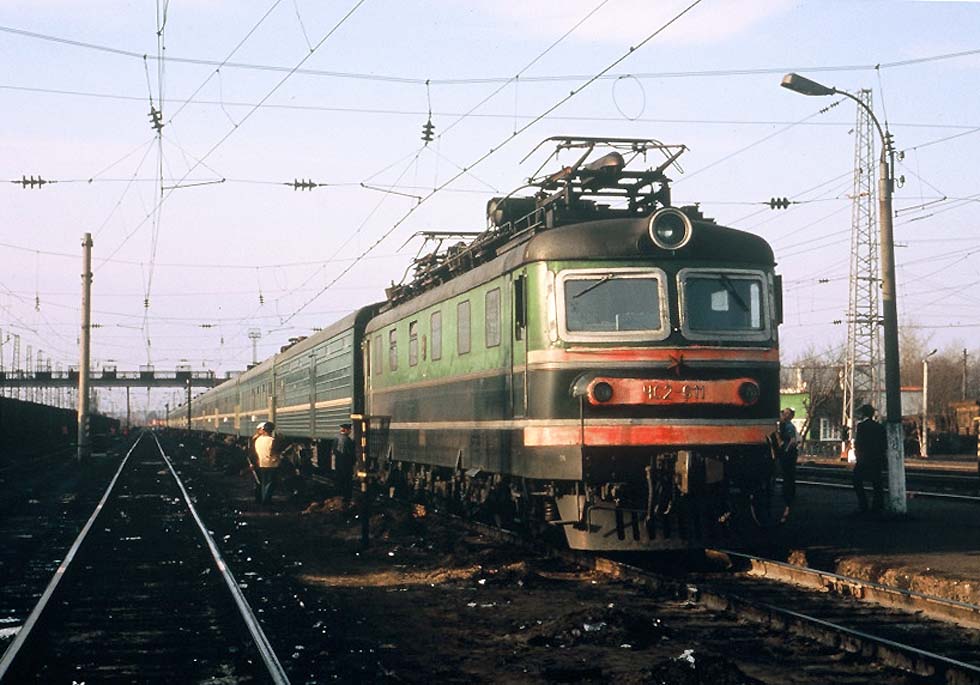
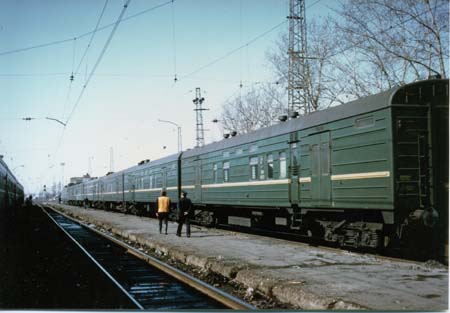
Traction, with 15 changes of locomotives: ChS2 and ChS4T (25kV0, VL60P/K and VL10 (3kV d.c.), diesel TE3 from Ulan-Ude on SZD; MTZ diesel TE2 from Naushki, 2M62M Sukhbaatar - Ulaanbaatar/-Dzamin Uud, TE2 to Erlian; KZD diesel DF4 and from Datong NY7 diesel-hydraulics. Westbound on Qinglongqiao ascent two NY7. In the 21st century new engines appeared in every country, in Mongolia even diesels from USA. Express 20 Moscow - Harbin - Beijing/ Pyongyang, in April 1988 (according to Dr. W. Wunderlich) 12 changes of SZD electric and diesel locomotives, from Zabaikalsk KZD diesel (1005?), from Manzhouli two DF3, from Angangxi 0115 (?), Harbin - Beijing BZ 3000 class. SZD cars, green. Express 1 Rossiya Vladivostok - Moscow in August 1966 (according to Dr. Fritz Stoeckl) between Skovorodino and Petrovski Zevod still steam (P36 and L, five engine changes), Ulan Ude-Slyudyanka P 36, Kirov-Danilov steam. SZD cars green/light green, later red, then green and in the 21st century completely new cars, also with luxury sleeping compartments were introduced.. Express 2 Rossiya Moscow - Vladivostok, Sept. 1987, from Moscow 20 cars, 17 changes of locomotives (electric and diesel), series ChS7, ChS4, ChS2, VL60, VL10, VL80, 2M62 (according to Leopold Prinz zu Schaumburg-Lippe). Express 4 Khabarovsk - Tikhookeanskaya (boat connection to Yokohama), summer 1966: 1 Bagazhnyi, 3 Mest 36 or 38, 3 Mest 16, 1 Restoran, 4 Mest 36 or 38. Traction SZD diesel TE3, later M62, then electric VL60 or VL80. During steam age Ye. SZD cars green. Soviet express passenger steam locomotives after 1924:
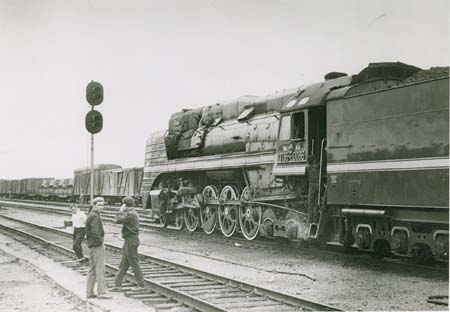
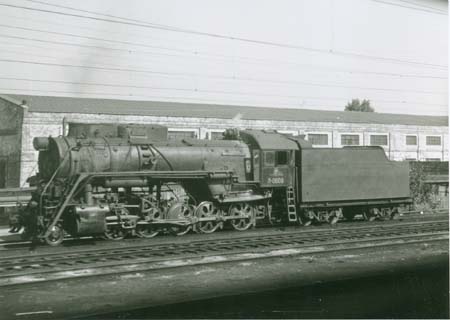
Also freight engines class L (2-10-0) hauled Siberian expresses. "Drug" was a Czech "present" for Stalin. The heavy 4-6-4 and 4-8-4 classes, planned since 1946, were not built. Among the German locomotives taken over were the 4-6-2 class TS (ex03 and, according to Hesselink also the streamlined 0310 ). Locomotives from Finland and Poland were requisitioned. Dutch 3700 (4-6-0) served at Daugavpils (according to Hesselink). Hungary supplied the 4-8-0 class TM (like the Hungarian 424), used in Ukraina.
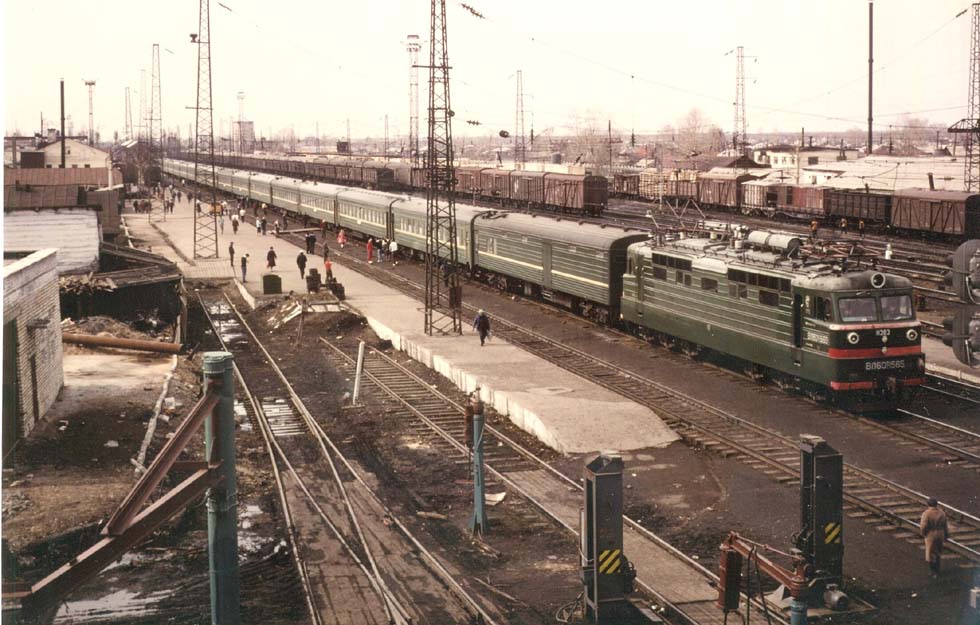 Express 20 Moscow - Harbin - Beijing and Pyongyang with VL60P/K and Soviet cars at Bogotol, April 1988 (Dr. Wilfried Wunderlich) 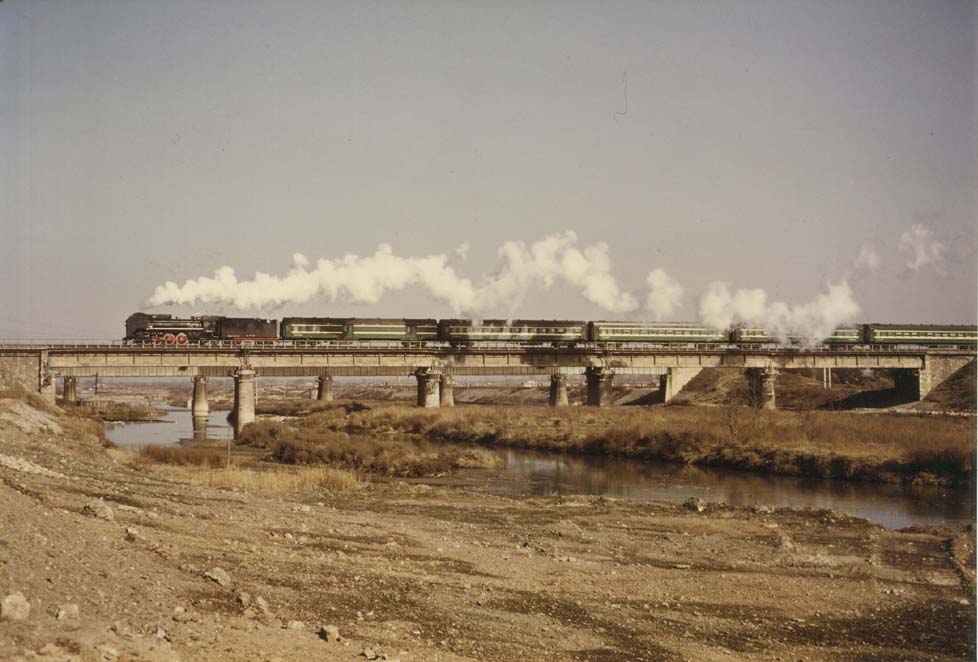 Chinese domestic train with RM class, which has hauled also the express from Moscow, in Manchuria 1988 (Irene Wardale)
Sakhalin Sakhalin, the remote island belonging to Russia, is connected with the Russian mainland by ferries (see www.ships-worldwide.com). They depart from Vanino, where passengers arrive by train from Khabarovsk on the Trans-Siberian railway. Vanino north of Vladivostok was a restricted area due to the military base of Sovietskiy Gavan. Regular passenger trains are not ferried. Contrary to the Trans-Siberian, the rail network on the island was built in Cape gauge, inherited from the early Japanese track. Now an express train even with sleeping-cars is running from Nogliki in the north to Yuzhno Sakhalinsk in the south. During Soviet time a dam, 7 km long and 30 m high, was planned to cross the Tatars Sound on its narrowest point, intended to divert the warm waters of the river Amur to the cold north. It should have been equipped with a railway line and without doubt it would have been connected with the 'Baikal-Amur-Magistral', completed in 1989 as a relief of the Trans-Siberian. The project was abandoned. In 1993 however the Jeuro Container Inc. published the proposal of connecting Nikolayevsk on the Amur with Sakhalin and even Hokkaido by gigantic road and railway bridges, thus targeting a direct way from Europe to Japan.
|