| trains-worldexpresses.com |

| |||||||
| TRAINS | World-Trains | Orient-Ex | Mideast | Indian Mail | Transsiberian | Rome-Ex | Cape to Cairo | Sud-Ex | ...adieu... |
|
The Myth |
Chronology |
Nord-Express |
Siberien-Express |
Nordroute |
Kurier 1 |
Transmanchourien |
Shanghai-Express |
Allied Forces |
Blauer Express | Moskva-Express | Eastern Europe | Baltics and Finland | Red Arrow | Moscow - Beijing | Tourist Specials | China | Far East | Japan | Travels - Reisen | Sibérie adieu | |||||||||
|
R e d A r r o w and H i g h S p e e d
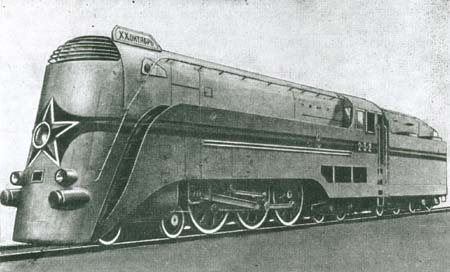
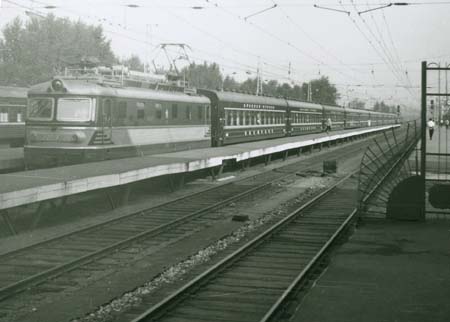
Half a dozen night trains continued running between Moscow and St. Petersburg. The Red Arrow did get a competitor, the blue Nikolayevski Express and in 2005 a new luxurious Express, appreciated by businessmen avoiding the dangers of Russian air travel. Krasnaya Strela Express Moscow Okt. - Leningrad Okt., 1954: Su (2-6-2) 8 Myagki (soft sleepers, mostly 2-berth, also 4-berth compartments), 1 Restoran 1 Pochtovyi Colors: dark-blue Krasnaya Strela Express Leningrad - Moscow, May 5, 1986:
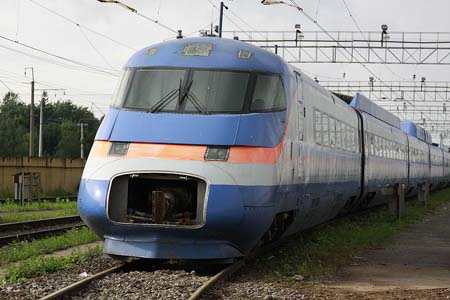
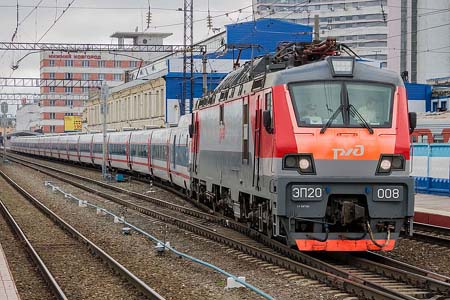
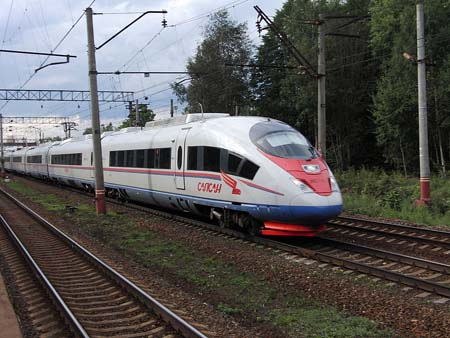
High-speed Among the 3kV dc electric locomotives the Czech ChS200 (2xBoBo) for 200 km/h, hauling the faster day train Aurora, and the similar ChS6 became predecessors of high-speeds services. In 1974 appeared the ER200 high-speed electric unit, but it remained a prototype. Also the development of the dual-system railcar "Sokol" VSM250 for a 250 km/h high-speed line was hampered. A high-speed track to the Black Sea, decided in 1988, of course was not built. In 2004, when Russian president Putin together with German chancellor Schroeder had an ICE trip through Northern Germany, a contract for a Russian high-speed train production based on the German ICE3 was signed. First services Moscow - St. Petersburg with a top speed of 250 km/h were intended for the end of the year 2007 and also services St. Petersburg - Helsinki and Omsk - Novosibirsk were planned. The project was delayed, but finally in 2008 Siemens presented its Velaro type high-speed train at St. Petersburg. The ICE3 variant “Sapsan” for 3kV DC was to take up St. Petersburg – Moscow services in late 2009, followed in 2010 by a 25kV50Hz variant running Moscow – Nizhni Novgorod. Extension of the network is expected. Not for true high-speed, but for a speed of 160km/h, a deal for the Desiro RUS was signed with Siemens in 2011. For international traffic from Moscow to Berlin and Prague, Talgo train sets with automatic gauge-changing were evaluated already around 2010. Among electric locomotives, the Czech-built of the 70s and other ones were replaced by new Russian types, twin and single, a.c., d.c. and dual-voltage, also in collaboration with foreign producers. In 2010 the Federal Passenger Company (FPC) was formed, described as a 100% subsidiary of RZhD.  High-speed prototype ER200 for St. Petersburg - Moscow, St. Petersburg 1992 (Hans-Herbert Frohn)
| |||||||||||||||||||||||||||||